
Hair Loss During Perimenopause & Andropause: Evidence-Based Treatment Options
Hair thinning and loss during midlife is treatable. Explore medical, hormonal, and procedural options backed by clinical evidence.
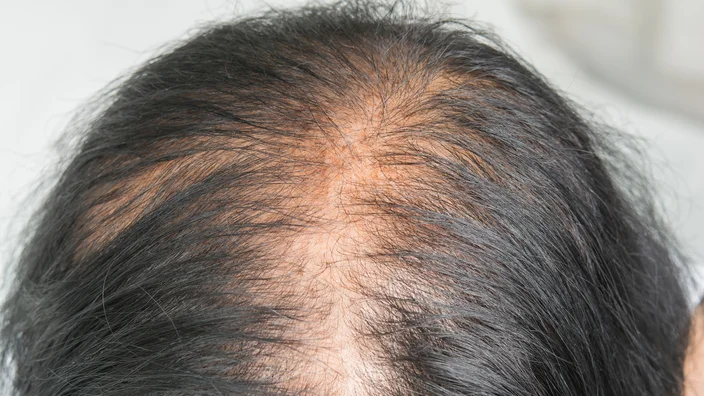
Hair thinning and shedding are among the most distressing — yet common — concerns during perimenopause and andropause. As estrogen, progesterone, testosterone, and DHT signaling shift, the hair follicle becomes more sensitive to hormonal imbalance, inflammation, and metabolic stress.
The good news? Hair loss during midlife is highly treatable when approached with evidence-based, individualized care.
Below is a clinically grounded overview of medical, hormonal, and procedural treatment options used in modern integrative practice.
Understanding Hormonal Hair Loss
Hormone-related hair loss typically presents as:
- Female Pattern Hair Loss (FPHL): diffuse thinning over the crown and part line
- Male Androgenetic Alopecia (AGA): recession at the temples and vertex thinning
Key drivers include:
- Declining estrogen and progesterone (reduced follicle protection)
- Increased androgen sensitivity (not always elevated levels)
- Elevated DHT activity at the follicle
- Insulin resistance, inflammation, micronutrient deficiency
- PCOS-related androgen excess
Effective treatment targets follicle stimulation, androgen modulation, and scalp health — often in combination.
First-Line Medical Therapy
Topical Minoxidil (2% or 5%)
Topical minoxidil remains the only FDA-approved treatment for female pattern hair loss and is a cornerstone therapy for all genders.
What the evidence shows:
- 2% and 5% formulations demonstrate similar efficacy
- Significantly higher rates of moderate to marked regrowth vs placebo
- Works by prolonging the anagen (growth) phase and improving follicular blood flow
Clinical pearls:
- 5% foam or solution is often used once or twice daily
- Initial shedding is common and expected
- Results require 6–12 months of consistent use
Oral Minoxidil (Low-Dose, Off-Label)
Low-dose oral minoxidil has gained widespread use in recent years, particularly for patients who struggle with topical adherence.
Typical dosing:
- 0.25–2.5 mg daily (women often start lower)
Benefits:
- Improved convenience and adherence
- Effective for diffuse shedding and miniaturization
Potential side effects:
- Transient shedding during initiation
- Hypertrichosis (unwanted facial/body hair)
- Mild peripheral edema
- Rare symptomatic hypotension
When prescribed thoughtfully and titrated slowly, oral minoxidil is well-tolerated in most patients.
Antiandrogen & Hormonal Therapy
Spironolactone
Antiandrogens are especially effective in women with hormonally mediated hair loss, particularly when combined with minoxidil.
- Effective dose: ≥100 mg/day
- Mechanism: blocks androgen receptors and reduces follicular DHT activity
Possible side effects:
- Breast tenderness
- Irregular menses
- Postural hypotension
- Hyperkalemia (requires monitoring)
Spironolactone is frequently used in perimenopausal women with concurrent acne, hirsutism, or androgen sensitivity.
5-Alpha Reductase Inhibitors (Finasteride & Dutasteride)
- Finasteride 1 mg daily shows limited benefit in premenopausal women
- Postmenopausal women may benefit, even without elevated androgens
- Dutasteride offers stronger DHT suppression but requires careful counseling
- These therapies are considered second-line and must be individualized.
Non-Pharmaceutical & Procedural Options
Low-Level Light Therapy (LLLT)
- Improves total hair count in controlled trials
- Noninvasive and well tolerated
- Best used as an adjunct, not a standalone therapy
Platelet-Rich Plasma (PRP)
- Uses autologous growth factors to stimulate follicles
- Particularly effective for early-stage thinning
- Often performed in a series of treatments
Microneedling (with or without Minoxidil)
- Enhances topical penetration
- Activates wound-healing pathways
- Evidence supports synergy with topical minoxidil
Nutritional & Integrative Support
Saw Palmetto
- Botanical 5-alpha reductase inhibitor
- Reduces DHT by ~30–40%
- May improve hair density in hormonally driven loss
Vitamin D & Micronutrients
- Vitamin D deficiency is strongly associated with hair shedding
- Supplementation improved hair pull test results in >80% of women with telogen effluvium
- Iron, zinc, and protein status should also be assessed
- Nutritional optimization supports the follicle — but rarely replaces medical therapy.
Surgical Options
Hair transplantation (FUE) remains an option for appropriate candidates, particularly in advanced loss. Importantly, ongoing medical therapy is still required to prevent progressive thinning of native hair.
A Personalized, Hormone-Informed Approach
Hair loss during perimenopause and andropause is not cosmetic — it is a biologic signal. The most effective treatment plans integrate:
- Hormone optimization
- Metabolic health assessment
- Targeted medical therapy
- Scalp-directed procedures
- Nutrient repletion
At Soluna Vitality, hair restoration is approached as part of a whole-body longevity strategy, not a one-size-fits-all prescription.
References
Olsen EA. Hair Loss in Women. New England Journal of Medicine. 2025;393(15):1509-1520. doi:10.1056/NEJMcp2412146.
van Zuuren EJ, Fedorowicz Z, Schoones J. Interventions for Female Pattern Hair Loss. Cochrane Database of Systematic Reviews. 2016;(5):CD007628. doi:10.1002/14651858.CD007628.pub4.
Akiska YM, Mirmirani P, Roseborough I, et al. Low-Dose Oral Minoxidil Initiation for Patients With Hair Loss: An International Modified Delphi Consensus Statement. JAMA Dermatology. 2025;161(1):87-95. doi:10.1001/jamadermatol.2024.4593.
Camacho-Martínez FM. Hair Loss in Women. Seminars in Cutaneous Medicine and Surgery. 2009;28(1):19-32. doi:10.1016/j.sder.2009.01.001.
Gupta AK, Mays RR, Dotzert MS, et al. Efficacy of Non-Surgical Treatments for Androgenetic Alopecia. Journal of the European Academy of Dermatology and Venereology. 2018;32(12):2112-2125. doi:10.1111/jdv.15081.
Huang Z, Zhao WJ, Gao YJ, et al. Botanical Drug Preparations for Alleviating Hair Loss in Menopausal Women. Frontiers in Pharmacology. 2025;16:1725691. doi:10.3389/fphar.2025.1725691.
Leavitt A, Hawkins SD, Kindred C, et al. Addressing the Root Causes of Female Hair Loss and Non-Pharmaceutical Interventions. Journal of Drugs in Dermatology. 2025;24(7):659-662. doi:10.36849/JDD.8763.
Drake L, Reyes-Hadsall S, Martinez J, et al. Evaluation of the Safety and Effectiveness of Nutritional Supplements for Treating Hair Loss. JAMA Dermatology. 2023;159(1):79-86. doi:10.1001/jamadermatol.2022.486.